


Tummy Tuck Recovery: A Complete Week-by-Week Guide
Tummy tuck recovery is one of the most important parts of achieving great abdominoplasty results. While the surgery removes excess skin and tightens abdominal muscles, your recovery process determines how quickly you heal and how your final results look. This week-by-week tummy tuck recovery guide explains exactly what to expect after surgery.
Abdominoplasty (the medical term for a tummy tuck) is one of the most transformative cosmetic surgeries out there. It removes excess skin, tightens abdominal muscles, and gives you a flatter, more toned midsection. But like any major surgery, the results you see at the end depend heavily on how well you recover.
This guide walks you through everything: what to expect week by week, how to manage discomfort, when to wear your compression garment, what to eat, what to avoid — and the signs that tell you something might be wrong.
Let’s start from day one.
Before We Begin: Why Recovery Matters as Much as the Surgery
A lot of people focus all their energy on choosing the right surgeon and preparing for the procedure. That makes sense. But here’s what most don’t realise: your surgeon’s work gets you 50% of the way there. Your recovery gets you the rest.
How you treat your body in the weeks and months after surgery directly affects your final results — the smoothness of your skin, the definition of your abdomen, and how quickly your scars fade. Cutting corners during recovery often means disappointing results, even after a perfectly performed procedure.
So take this guide seriously. Your results depend on it.
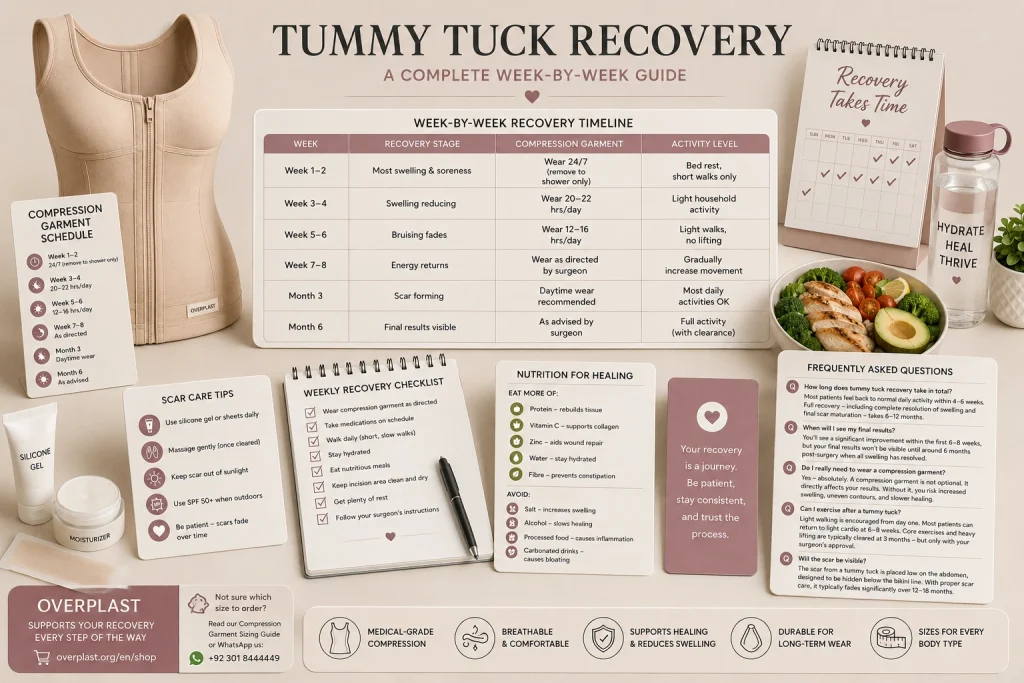
Week-by-Week Tummy Tuck Recovery Timeline
| Week | Recovery Stage | Compression Garment | Activity Level |
| Week 1–2 | Most swelling & soreness | Wear 24/7 (remove to shower only) | Bed rest, short walks only |
| Week 3–4 | Swelling reducing | Wear 20–22 hrs/day | Light household activity |
| Week 5–6 | Bruising fades | Wear 12–16 hrs/day | Light walks, no lifting |
| Week 7–8 | Energy returns | Wear as directed by surgeon | Gradually increase movement |
| Month 3 | Scar forming | Daytime wear recommended | Most daily activities OK |
| Month 6 | Final results visible | As advised by surgeon | Full activity (with clearance) |
Week 1–2: The Hardest Part (And How to Get Through It)
Let’s be honest — the first two weeks are uncomfortable. You’ll feel sore, stiff, and tired. This is completely normal. Your body has just been through major surgery and it needs time and rest.
What to Expect:
- Significant swelling and bruising around your abdomen
- Drainage tubes may still be in place for the first few days
- You’ll be walking in a slightly hunched position — this is normal and protects your incision
- Pain that’s manageable with prescribed medication
- Fatigue — your body is using a lot of energy to heal
Your Compression Garment in Week 1–2:
This is the most critical phase for your garment. Wear it 24 hours a day, 7 days a week — only remove it when showering. The compression during this phase controls swelling, supports the surgical area, and helps your skin begin conforming to its new contour.
Tip: Have two garments so you can alternate while one is being washed. OverPlast garments are quick-dry — but always air dry, never use a dryer.
Dos and Don’ts — Week 1–2:
- ✅ Rest as much as possible
- ✅ Take short, slow walks every few hours to prevent blood clots
- ✅ Sleep on your back with pillows under your knees to reduce tension
- ✅ Keep your incision area clean and dry
- ✅ Take your medications on schedule
- ❌ Don’t lift anything heavier than a cup of tea
- ❌ Don’t shower for the first 24–48 hours (follow your surgeon’s specific advice)
- ❌ Don’t drive while on pain medication
- ❌ Don’t ignore unusual pain, fever, or discharge from the incision
Week 3–4: Starting to Feel Human Again
By week three, most patients notice a real shift. The worst of the swelling starts to reduce, bruising begins to fade, and you start feeling more like yourself. You’ll still need to take it easy, but there’s light at the end of the tunnel.
What to Expect:
- Swelling gradually decreasing (though it won’t be fully gone yet)
- You’ll begin standing more upright
- Mild itching around the incision — this means it’s healing
- Drainage tubes typically removed by now
- You may feel well enough to return to light desk work or working from home
Your Compression Garment in Week 3–4:
Your surgeon may allow you to remove the garment at night during this phase — but this varies. Some surgeons recommend continuing 24-hour wear through week four. Follow their specific instructions.
If you notice increased swelling when you remove the garment, that’s your body telling you it still needs the support. Put it back on.
Week 5–8: Getting Back to Normal
This phase is where most patients start feeling like the surgery was worth it. Swelling continues to reduce, your energy comes back, and you can start taking on more of your regular routine.
What to Expect:
- Visible reduction in swelling — your new shape becomes clearer
- Bruising mostly gone
- Scar still pink/red but beginning to flatten
- Increased energy and mobility
- Light exercise (walking, gentle stretching) may be cleared by your surgeon
What to Avoid:
- ❌ Heavy lifting or intense exercise — this can strain your abdominal muscles and open the incision
- ❌ Swimming (until your surgeon clears you — usually after 6–8 weeks)
- ❌ Sun exposure on the scar — UV light darkens scars significantly
- ❌ Tight clothing other than your compression garment
Month 3–6: The Final Transformation
This is the phase that most people underestimate. Swelling can take up to 6 months to fully resolve — especially deep swelling that you might not even see but can feel as firmness or tightness.
Your scar will go through changes during this time. It may look red or raised at first, then gradually flatten and lighten. Following your scar care routine is essential during this phase.
Scar Care Tips:
- Apply silicone gel or sheets to the scar daily — this is one of the most effective ways to minimise scarring
- Massage the scar gently with your fingers once cleared by your surgeon
- Keep the scar out of direct sunlight, or apply SPF 50+ if you go outdoors
- Stay hydrated and eat a protein-rich diet to support skin healing
Nutrition During Recovery: What to Eat (and What to Avoid)
What you eat during recovery affects how quickly you heal. Here’s a simple guide:
Eat More Of:
- Protein — chicken, fish, eggs, lentils. Protein rebuilds tissue and speeds healing.
- Vitamin C — oranges, strawberries, capsicum. Essential for collagen production and scar healing.
- Zinc — nuts, seeds, legumes. Supports immune function and wound repair.
- Water — stay well hydrated. Dehydration slows healing and worsens swelling.
- Fibre — fruits, vegetables, whole grains. Prevents constipation (a common issue after surgery).
Avoid:
- Salt — increases fluid retention and worsens swelling
- Alcohol — interferes with medications and slows healing
- Processed and fried food — causes inflammation
- Carbonated drinks — can cause bloating and discomfort with your abdominal incision
Frequently Asked Questions
How long does tummy tuck recovery take in total?
Most patients feel back to normal daily activity within 4–6 weeks. Full recovery — including complete resolution of swelling and final scar maturation — takes 6–12 months.
When will I see my final results?
You’ll see a significant improvement within the first 6–8 weeks, but your final results won’t be visible until around 6 months post-surgery when all swelling has resolved.
Do I really need to wear a compression garment?
Yes — absolutely. A compression garment is not optional. It directly affects your results. Without it, you risk increased swelling, uneven contours, and slower healing.
Can I exercise after a tummy tuck?
Light walking is encouraged from day one. Most patients can return to light cardio at 6–8 weeks. Core exercises and heavy lifting are typically cleared at 3 months — but only with your surgeon’s approval.
Will the scar be visible?
The scar from a tummy tuck is placed low on the abdomen, designed to be hidden below the bikini line. With proper scar care, it typically fades significantly over 12–18 months.
Your Recovery Starts with the Right Support
According to the American Society of Plastic Surgeons, compression garments play an important role in managing swelling and supporting recovery after body contouring procedures.
A successful tummy tuck recovery isn’t just about following instructions — it’s about having the right tools in place from day one.
The most important tool? A high-quality compression garment that fits properly, stays in place, and supports your body through every stage of healing.
OverPlast compression garments are designed specifically for post-surgical recovery in Pakistan — breathable for our climate, durable for long-term wear, and available in sizes and styles for every body type.
👉 Browse Tummy Tuck Compression Garments
📏 Not sure which size to order? Read our → Compression Garment Sizing Guide or WhatsApp us: +92 301 8444449